

Anu the Pious Monk
A short dark story, set in Thailand

The air in Wat Pa Kham was thick enough to chew, a humid broth of incense, old wood, and the quiet desperation of men who had given up the world. For Anu, it was a prison. He’d been ‘placed’ here, a euphemism for exiled, by a senior monk who had tired of his insolence and his late-night excursions with friends from his old life. Friends who could get you cheap whiskey and easier girls. Friends who were now just a sweaty, distant memory.
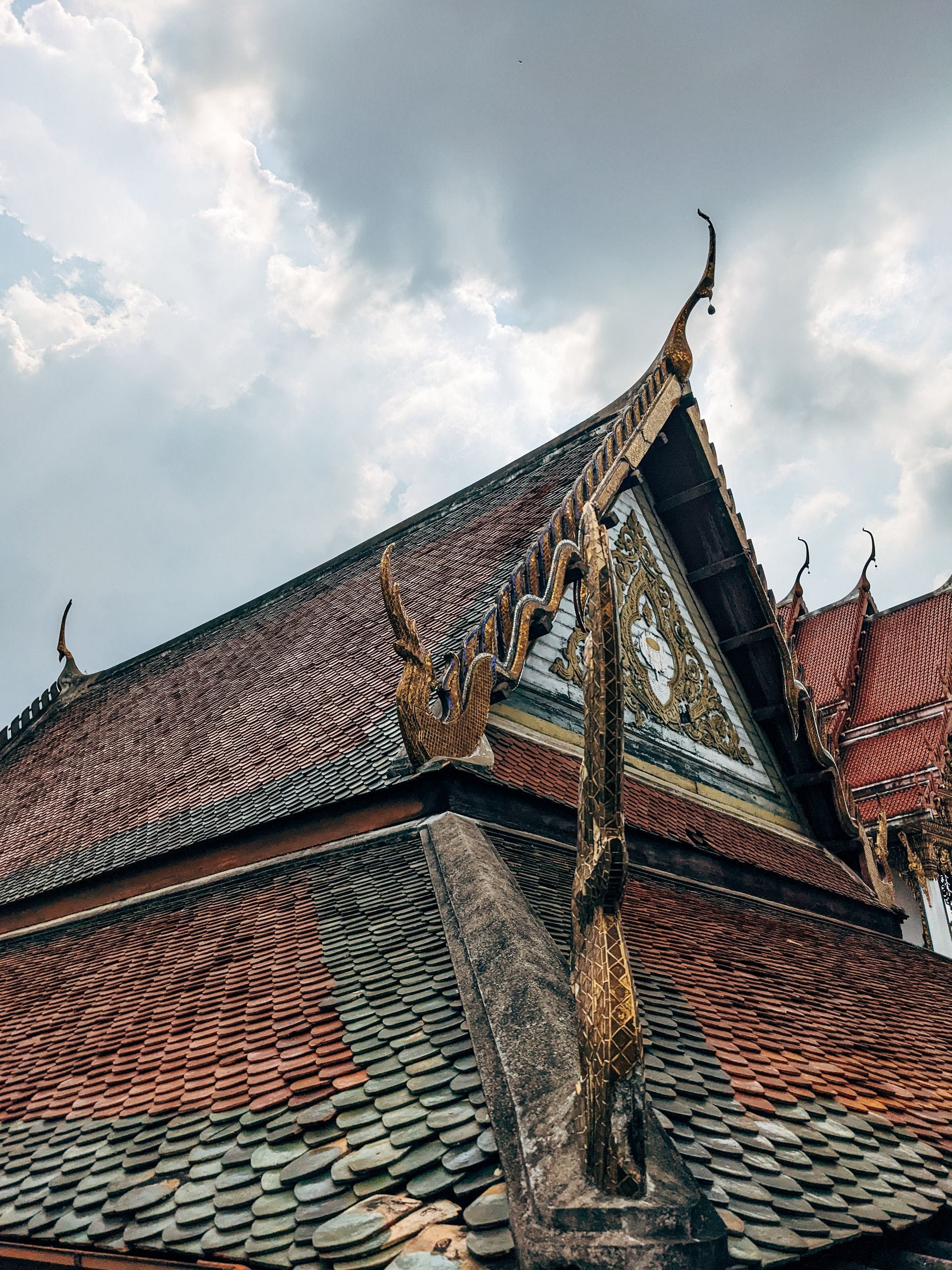
The temple was ancient, its wooden structures groaning under the weight of the jungle that pressed in on all sides. The other monks were a collection of grey, silent men, their faces as weathered and unreadable as the Buddha statues that lined the ordination hall. They moved with a practised lethargy, their saffron robes the only splash of colour in the perpetual green-brown gloom. Their leader, the abbot, was a man named Luang Por Somsin. He had eyes like polished river stones and a voice that could strip paint. He was the warden of this particular hell, and Anu was his newest, most troublesome inmate.
Anu’s rebellion was petty and constant. He’d drag his feet during morning alms rounds, forcing the other monks to wait. He’d complain about the bland, tasteless food, a diet of sticky rice and watery jungle vegetables. He’d take the longest, coldest showers, and when he chanted, his voice was a flat, monotone drone, deliberately off-key to annoy the others. But his true weapon was his silence. He was a master of the cold shoulder, a quiet, simmering resentment that soured the air around him.
The first death was an accident. Everyone agreed on that. A young novice, barely fourteen, was sent to collect firewood. The jungle was treacherous, slick with moss and crawling with things that could kill you. The boy, a nervous, studious kid named Aran, slipped on a mossy root and tumbled down a ravine, cracking his head on a sharp rock. They found him hours later, cradled in the ferns, his eyes wide and glassy, looking up at the canopy that had swallowed the sky. The other monks whispered and prayed, their faces etched with genuine sorrow. Anu felt nothing but a flicker of irritation at the disruption to his day. The funeral was quiet, the boy’s body cremated on a simple pyre. The only person Anu saw shed a real tear was the temple cat, a mangy creature that had often slept curled beside the boy.
The atmosphere in the temple shifted after Aran’s death. The silence became heavier, charged with a new, unspoken dread. The looks the other monks gave Anu were no longer just disapproving; they were laced with fear. He caught fragments of whispers, the name ‘Anu’ and the Thai word for ‘bad luck’—karma—hanging in the air like the smoke from the incense. He didn’t care. Let them be afraid. It was better than their pity.
The second death was more unsettling. Luang Por Somsin’s favourite student, a gentle, reliable monk named Phra Prasert, was found dead in the library. He was slumped over a dusty Pali manuscript, a single, perfect drop of blood crystallised on his temple. There were no signs of a struggle, no wounds other than that small, scarlet bead. The cause of death was a mystery. The village doctor, summoned from miles away, could only shake his head and mutter about a stroke or a heart attack. But the monks knew. They had seen the quiet fury in Anu’s eyes when Phra Prasert had politely corrected his chanting the previous evening. They had seen the way Anu’s jaw had clenched, the venom in his fleeting glance.
Anu, for his part, was unnerved for the first time. He hadn’t laid a finger on Phra Prasert. He’d been in his own small kuti, the crude bamboo hut that served as his cell, seething over the correction, not killing the man. But no one believed him. The walls of the temple had ears, they said, and the spirits saw all. And Anu’s spirit, they were beginning to suspect, was a dark and vengeful one.
The third death broke the temple. It was Luang Por Somsin himself. The old abbot was found in the ordination hall, kneeling before the main Buddha statue. His posture was one of perfect, peaceful meditation. But his face was frozen in a mask of sheer, unadulterated terror. His eyes were wide, staring at something only he could see, and his mouth was open in a silent scream. There were no marks on him. He had been scared to death.
This was no accident. This was no stroke. This was an assassination of the spirit. The remaining monks were in a state of panic. Their spiritual leader, the man they believed was shielded by a lifetime of merit, had been struck down by malevolence personified. They didn’t need a detective. They didn’t need a trial. They had their suspect. Anu.
Anu felt the noose tighten. He saw the way they huddled together when he walked past, their hands clutching their amulets, their eyes refusing to meet his. He heard the frantic, low murmurs that stopped the second he came within earshot. They were planning something. They were going to exorcise him, or worse. In the eyes of the law, a monk couldn’t kill. But in the eyes of the temple, an evil spirit could be driven out. Or it could be contained.
That night, the senior monks came for him. They were led by a stocky, bull-necked man named Phra Ajaan Perm, who had always been the abbot’s right hand. Their faces were hard, their resolve absolute. They didn’t speak to Anu; they simply surrounded him and began to chant. It wasn’t the peaceful, melodic chanting of the morning prayers. This was a guttural, rhythmic invocation, an ancient and aggressive script designed to repel demons. They held him in the centre of the circle, their voices rising in a cacophony that reverberated off the bamboo walls. Anu felt his own anger surge in response, a hot, defensive rage that was completely human. He opened his mouth to scream at them, to tell them they were all insane, that he was no killer.
But the words wouldn’t come.
A new sound cut through their chanting. It was a thin, reedy, high-pitched wail, a sound of profound and unending misery. It came from outside, from the direction of the jungle. The chanting faltered. The monks looked at each other, their confident anger replaced by naked terror. The sound grew louder, closer. It was the cry of a soul in torment.
And then, it was inside.

It didn’t have a form, not a solid one. It was more a coalescence of darkness and sorrow, a sentient shadow that seeped through the cracks in the walls and swirled in the dim lamplight. It was cold. The temperature in the hut plummeted, and Anu could see his own breath misting in front of him.
The entity hung in the air, an absence of light that felt somehow dense and heavy. It was a darkness that was not simply the absence of photons, but a presence that was alive with ancient anguish. And from its core, the wailing continued, a sound that bypassed the ears and scraped directly against the soul.
Phra Ajaan Perm, his face pale, raised his hand, chanting a protective mantra. The shadowy form pulsed, and a wave of pure, psychic despair washed over him. He staggered back, clutching his head, his own protective chants dying on his lips. He sank to his knees, his eyes wide with the same uncomprehending terror that had frozen Luang Por Somsin’s face.
The other monks scattered, screaming, their robes flapping as they fled into the night. They were no longer a mob of righteous executioners; they were a flock of terrified men, abandoning their supposed demon to its fate.
Anu was left alone with the entity. He was frozen, not just by fear, but by a strange sense of recognition. The sorrow pouring from the shadow was familiar. It was an echo of his own anger, his own sense of being an outcast, a prisoner.
The wailing softened, becoming a choked sob. The darkness coalesced, its form becoming a little clearer. It was a small, hunched shape, and it was crying. It was mourning.
From the swirling blackness, a single, translucent hand reached out. It wasn’t reaching for Anu. It was pointing, past him, to a small, forgotten corner of the temple grounds. It pointed to where the temple’s ancient, crumbling water well stood, choked with weeds and forgotten.
And then, the entity slowly faded, its sound dissolving into the oppressive silence of the night, leaving behind only the scent of damp earth and decaying leaves.
Anu sat for a long time, his heart hammering against his ribs. The fleeing monks didn’t return. The night stretched on, silent and terrifying. When dawn finally broke, casting a sickly, watery light through the trees, Anu was the only one left in the monastery.
He walked, on shaking legs, to the old well. He peered over the crumbling stone edge. The water, if there was any, was far below, hidden in a darkness that was not the same as the one from the night before. He saw nothing but a yawning black hole. But he knew it was down there—the source of it all.
Hours later, the village’s only policeman, a man with the weary look of someone who had seen too much and fixed too little, arrived with the district officer. They had heard the rumours, the panicked tales of a demon-possessed monk who had killed his elders. They expected a madman. They found Anu sitting calmly in the ordination hall, staring at the serene face of the Buddha.
He watched them, his face impassive, as they searched the temple. He did not explain, no defence. He was the only one left to blame. He was the scapegoat, the only vessel for their fear and their need for an ending to this horror.
The discovery was a footnote to the investigation. A junior officer, inspecting the grounds to catalogue the property of the now-defunct Wat Pa Kham, noticed the old well. He looked inside and was overcome by the stench. They had to use ropes to retrieve the object. It was a heavy, old, bronze samrit box, ornate and sealed with a thick crust of wax and rust. Inside, wrapped in oilcloth, were the skeletal remains of a child. They were ancient, the bones small and brittle. Tucked beside the skull was a small, tarnished brass plaque. On it, scratched in crude, ancient script, was a name: ‘Niran’.
The policeman, a man not given to flights of fancy, felt a cold dread seep into his bones. He remembered the old story, the one the villagers told to frighten their children. A story of an orphan boy, a temple child named Niran, who had been found drowned in a well centuries ago. It was said jealous monks had murdered him, his small body thrown into the water, his spirit left to wander, trapped and alone, for eternity. A spirit that would manifest as a deadly sorrow, a cold curse on the monastery that had wronged it.
Anu was watched, but never arrested. Without a body or a confession, there was no case. The temple was declared unsafe, its land reclaimed by the jungle. Anu was relocated, placed in yet another temple, this one in a busy city, where the constant hum of traffic and the proximity of so many living souls seemed to ward off any spectre.
He spent his days there in silence. He was still a delinquent, still sullen and difficult, but there was a new, deeper silence in him now. A haunted quiet. He knew the truth. His petty acts of rebellion, his mean spirit, his sullen resentment—they hadn’t killed anyone. He had been a mosquito buzzing around a festering wound, insignificant and annoying.
The real killer was a ghost of a child, a spirit who had been wronged a thousand years ago, a sorrow so profound that it had leaked from its watery grave and fed on the fear and unease his own presence had created. He had been the catalyst, but the poison was ancient, far older than his young, angry soul. The world, he finally understood, was not about the small malevolence of boys like him. It was full of older, deeper, and infinitely darker things.
The END
More of Colin Devonshire’s stories FREE for a few days - HERE or HERE

A no dialogue story- I didn't think this was possible...
Thanks again Colin