

The Last Mushroom

The Chonlatee Intarat Mysteries
The Letter
My dearest Mali,
By the time you read this, I will be gone and not gone as in dead, though that will come soon enough. Gone as in left. Walked away. I chose my own path.
The doctors gave me three months. Maybe four. The cancer is in my bones now, and the pain is... I don't have words. You've seen me cry at night when I thought you were sleeping. You've heard me scream in the bathroom with the water running. You know.
I can't do that to you anymore. I can't do it to myself.
I've found someone who can help. He calls himself the Gardener. He doesn't ask for money. He doesn't ask for names. He only asks that you come when you're ready—truly ready—and that you leave everything behind.
I'm ready, Mali. I've been ready for months. But I stayed because I loved you. Because I didn't want to leave you alone. But the pain has become louder than love. Louder than fear. Louder than anything.
Please don't look for me. Please don't hate me. Please remember me as I was—before the sickness, before the screaming, before I became a ghost in my own body.
I love you. I've always loved you. And that's why I have to go.
Your Pong
The letter arrived on a Tuesday, tucked inside an envelope with no return address. Mali read it once, twice, three times. Then she called the police.
They took a report. They asked questions. They promised to investigate.
But Pong had been gone for three weeks. The trail was cold. The police had other cases—murders, robberies, the living demanding attention. A dying man who walked away was not a priority.
Mali knew this. She had known it the moment she picked up the phone.
So she did the only thing she could think of.
She called a woman she had read about in the newspaper. A woman who counted things. A woman who found what others missed.
She called Chonlatee Intarat.
Chonlatee Intarat was reorganising her bookshelf by colour when her phone rang.
It was a Tuesday—her designated day for literary order—and the books had fallen into chaos after the Kanchanaburi case. Reds next to oranges, blues next to greens, a gradient that soothed something deep in her brain.
She answered without looking at the screen.
"Khun Chonlatee? This is Mali Srisawat. I got your number from a friend of a friend. I need your help."
Chon set down a red-covered novel. "What kind of help?"
"My husband disappeared. Three weeks ago. He left a letter saying goodbye. He has cancer. Stage four. The police won't do anything because they think he just... walked away to die."
"Did he?"
"I don't know. That's what I need you to find out." Mali's voice cracked. "I need to know if he's dead. Or if he's out there somewhere, alone, suffering. I need to know."
Chon had taken cases like this before—missing persons, usually elderly, usually sick. Most of them were found within days, confused or disoriented, wandering far from home. But some were never found. Those were the ones that haunted her.
"I'll need to see the letter. And anything else you have. His medical records. His phone. His computer."
"Come to my house. I'll show you everything."
Mali Srisawat lived in a modest house in the suburbs of Bangkok, surrounded by fruit trees and a garden that had gone to seed. She was younger than Chon expected—maybe forty-five—with hollow eyes and hands that trembled.
"The letter," she said, handing it over. "He left it on the kitchen table. Along with his wedding ring."
Chon read the letter. The handwriting was shaky but deliberate. The words were careful, almost poetic.
He calls himself the Gardener.
"Who is the Gardener?" Chon asked.
"I don't know. Pong never mentioned anyone by that name. But he'd been going to support groups. For cancer patients. Maybe he met someone there."
"Support groups. Where?"
"At the hospital. Siriraj. He went every Tuesday."
Chon made a note. "Did he ever talk about wanting to end his life? Euthanasia? Assisted suicide?"
Mali's face crumpled. "He talked about the pain. Every day. He said it was unbearable. But he never said he wanted to die. He said he wanted to live. He wanted to see our daughter graduate. He wanted to grow old with me."
"But he left."
"He left." Mali wiped her eyes. "Maybe he changed his mind. Maybe the pain became too much. I don't know. That's what I need you to find out."
Chon looked at the letter again. The phrase the Gardener stood out. It was specific. It was a name, a title, a clue.
"I'll do what I can," Chon said. "But I need to warn you—I may not find him. And if I do, he may not be alive."
Mali nodded. "I know. I just need to know."
The cancer support group met in a small room at Siriraj Hospital, surrounded by pamphlets about chemotherapy, hope, and fighting spirit. Chon arrived early, before the meeting started, and spoke to the facilitator—a tired-looking social worker named Khun Jit.
"Pong Srisawat," Khun Jit said, scrolling through her records. "Yes, he attended regularly. Very quiet. Very sad. He stopped coming about a month ago."
"Did he ever mention someone called the Gardener?"
Khun Jit's face flickered—recognition, maybe, or fear. "No. But some of the patients talk about... alternatives. Things outside the hospital. I try to discourage it."
"What kind of alternatives?"
"Herbal remedies. Meditation retreats. Mushroom therapies." Khun Jit lowered her voice. "There's a man who comes to the hospital sometimes. He's not a doctor. He doesn't work here. But he talks to patients in the waiting room. Offers them hope."
"What's his name?"
"I don't know. He doesn't give a name. He... appears. And then he disappears with someone. And that someone never comes back."
Chon's blood went cold. "How many?"
"Three that I know of. Maybe more." Khun Jit's hands shook. "I reported it to hospital administration. They said there was no evidence of wrongdoing. The patients left voluntarily. They weren't coerced."
"But they were dying."
"Yes. And maybe they wanted to die somewhere else. With someone else." Khun Jit looked at Chon. "But I've seen the families. The ones left behind. They don't get closure. They don't get bodies. They don't get anything except a letter and an empty bed."
Chon thought of Mali, alone in her garden, waiting for news that might never come.
"Can you describe the man?"
"Middle-aged. Thin. Bald. He wears glasses and always carries a leather satchel. He speaks softly, calmly. He has a way of making you feel like everything will be okay." Khun Jit paused. "And he has a tattoo on his right hand. A mushroom. A small mushroom, like something from a fairy tale."
Chon wrote it down. A mushroom tattoo. A man who offered alternatives. Patients who disappeared.
"The Gardener," Chon said.
"That's what they call him. Yes."
While Chon was at the hospital, Margaret was doing her own research—calling contacts, searching databases, following the digital breadcrumbs that the Gardener had left behind.
She called Chon that evening, her voice grim.
"Darling, I've found something. Three other missing persons have terminal illnesses. All from Bangkok. All left letters. All mentioned the Gardener."
"Names?"
"Sumalee, fifty-two, ovarian cancer. Left a letter to her sister. Vitoon, sixty, lung cancer. Left a letter to his son. And... someone else. Someone closer to home."
Chon's heart stopped. "Who?"
"A patient at your brother's hospital. A woman named Pranee. She's been receiving treatment for ALS. She disappeared two days ago. Left a letter on her bed."
Chon felt the world tilt. Her brother's hospital. The place she visited every week. The place where sick people went to get better—or to die.
"I need to see that letter."
"Already sent it to your phone. Read it. Then call me back."
The letter was shorter than Pong's, but the handwriting was similar—shaky, deliberate, resigned.
To whoever finds this,
I'm sorry. I know this will hurt you. But I can't stay. The disease is eating me alive, and I can't watch my family suffer anymore.
I've found the Gardener. He promised me peace. He promised me an end to the pain. I believe him.
Please don't look for me. Please remember me as I was. Please live.
Pranee
Chon read it twice. Then she called Margaret.
"This is bigger than one missing person," Chon said. "This is a network. A system. The Gardener is recruiting terminally ill patients and facilitating their deaths."
"But is it murder? They're going willingly. They're asking for help."
"The mushrooms—psilocybin, probably—are illegal in Thailand. Even if he's giving them a peaceful death, he's breaking the law. And the bodies—where are the bodies? He's making them disappear. That's not euthanasia. That's concealment."
"Or maybe he's burying them in a special place. A garden, perhaps." Margaret's voice was thoughtful. "The Gardener. It's not just a name. It's a clue."
"A garden where he plants the bodies?"
"Or where he plants something else. Mushrooms grow on decaying matter, Chon. On death."
Chon felt a chill. "You think he's using the bodies to grow more mushrooms?"
"I think he's a man with very odd beliefs. About death. About pain. About when you're ready to go." Margaret paused. "I've heard of people like this. They call themselves death doulas. They help the terminally ill end their lives with dignity. But the ones who do it illegally—they're often cult leaders. They attract followers. They build compounds."
"Then we need to find his compound. Before more people disappear."
"Agreed. But we need to be careful. These people—the ones who go to him—they're not victims in the traditional sense. They're choosing this. They want to die."
Chon thought about that. About pain. About choice. About the difference between helping someone die and killing them.
"I know," she said. "But the families left behind—they deserve answers. And the law is the law."
"Even when the law is cruel?"
"Even then."
Margaret sighed. "You sound like your mother. Stubborn. Principled. Impossible to argue with."
"I'll take that as a compliment."
"Take it however you like. Just find him before someone else does."
Chon visited her brother the next day, as she did every Thursday. He was sitting in the garden, staring at a butterfly, his face peaceful.
"Sis. You're worried."
She sat beside him. "I'm always worried."
"More than usual." He turned to look at her. "Someone's missing. Someone from here. A woman named Pranee."
Chon's heart skipped. "How do you know that?"
"I heard the nurses talking. They said she left a letter. They said she went to find peace." He tilted his head. "Do you think she found it?"
"I don't know. That's what I'm trying to find out."
"Pranee was in the room next to mine. She couldn't move her arms anymore. She couldn't feed herself. But she could still talk. She talked to me sometimes. About her daughter. About her garden. About the mushrooms she used to grow."
Chon leaned forward. "Mushrooms?"
"Magic mushrooms, she called them. She said they opened her mind. Helped her see things differently." He smiled. "She said she wanted to see them one more time before she died."
"Did she say where she got them?"
"No. But she said a man visited her. A man with a kind voice and a mushroom tattoo. He told her about a place where the pain stops. Where can you let go?"
"The Gardener."
"Is that what they call him?" Her brother shrugged. "He seemed nice. He made her smile. That's more than the doctors ever did."
Chon felt a knot in her chest. Her brother was sick too—not terminal, not yet, but his mind was slipping away. Someday, maybe, he would be in pain. Someday, maybe, someone like the Gardener would come to him.
"You're thinking about me," her brother said. "Stop. I'm not going anywhere."
"How do you know?"
"Because I'm not ready." He took her hand. "When I'm ready, I'll tell you. But not yet. There's still too much to see. Too much to dream."
Chon squeezed his hand. "Promise me you'll tell me. Before you do anything."
"I promise."
She stayed with him until visiting hours ended, watching the butterfly, counting its wingbeats, trying not to think about the Gardener and his garden of death.
Margaret's contacts yielded results within two days. The Gardener had been seen in several provinces—Chonburi, Rayong, Trat—always near the coast, always near the mountains.
"He's moving," Aunt Margaret said, spreading a map across the table at the Gilded Lotus. "He doesn't stay in one place for long. He finds patients, recruits them, takes them somewhere, and then moves on."
"Where do the bodies go?"
"That's the question." Margaret tapped the map. "There's a region in Trat province—near the border with Cambodia—that's remote, forested, largely unpatrolled. It would be easy to hide bodies there. Or to build a compound."
"Or to grow mushrooms."
"Or to grow mushrooms." Margaret looked at her. "I've been thinking about what you said about the mushrooms. Psilocybin is illegal in Thailand, but it grows wild in certain regions. The Gardener could be harvesting it. Or cultivating it."
"Using the bodies as fertiliser?"
"Gruesome. But possible." Margaret's face was grim. "I've also been thinking about something else. About myself."
Chon looked at her. "What?"
"I'm old, Chon. Seventy-six. I've lived a full life. A dangerous life. I've seen things that would break most people." Aunt Margaret's voice was quiet. "And I've been in pain. Not the kind of pain Pong had—not cancer—but the kind that comes from knowing you're closer to the end than the beginning."
"Aunt Margaret—"
"I'm not saying I want to find the Gardener. I'm saying I understand why people do." Margaret met her eyes. "When you're old and sick and tired, the idea of a peaceful death—a beautiful death—it becomes appealing. Even tempting."
Chon felt fear rise in her chest. "You're not sick."
"Not yet. But I will be. We all will be." Aunt Margaret touched her hand. "I'm telling you this because you need to understand. The people who go to the Gardener—they're not crazy. They're not weak. They're just... tired. And they've found someone who promises to make the ending less painful."
"You're defending him."
"I'm explaining him. There's a difference." Margaret stood. "Now. Let's find him before he takes anyone else."
The trail led them to Trat province, to a remote area near the Khao Banthat mountain range. Chon drove; Margaret navigated; Ning had stayed behind to manage the shop.
The road narrowed to dirt, then to gravel, then to nothing. They parked and walked through the forest, following a barely visible path.
"Someone comes here regularly," Chon said, pointing to broken branches and footprints. "Recent. Within the last few days."
Aunt Margaret nodded. "The Gardener."
They walked for another hour, the forest growing denser, the air growing cooler. And then they saw it.
A clearing. A garden.
But not a garden of flowers.
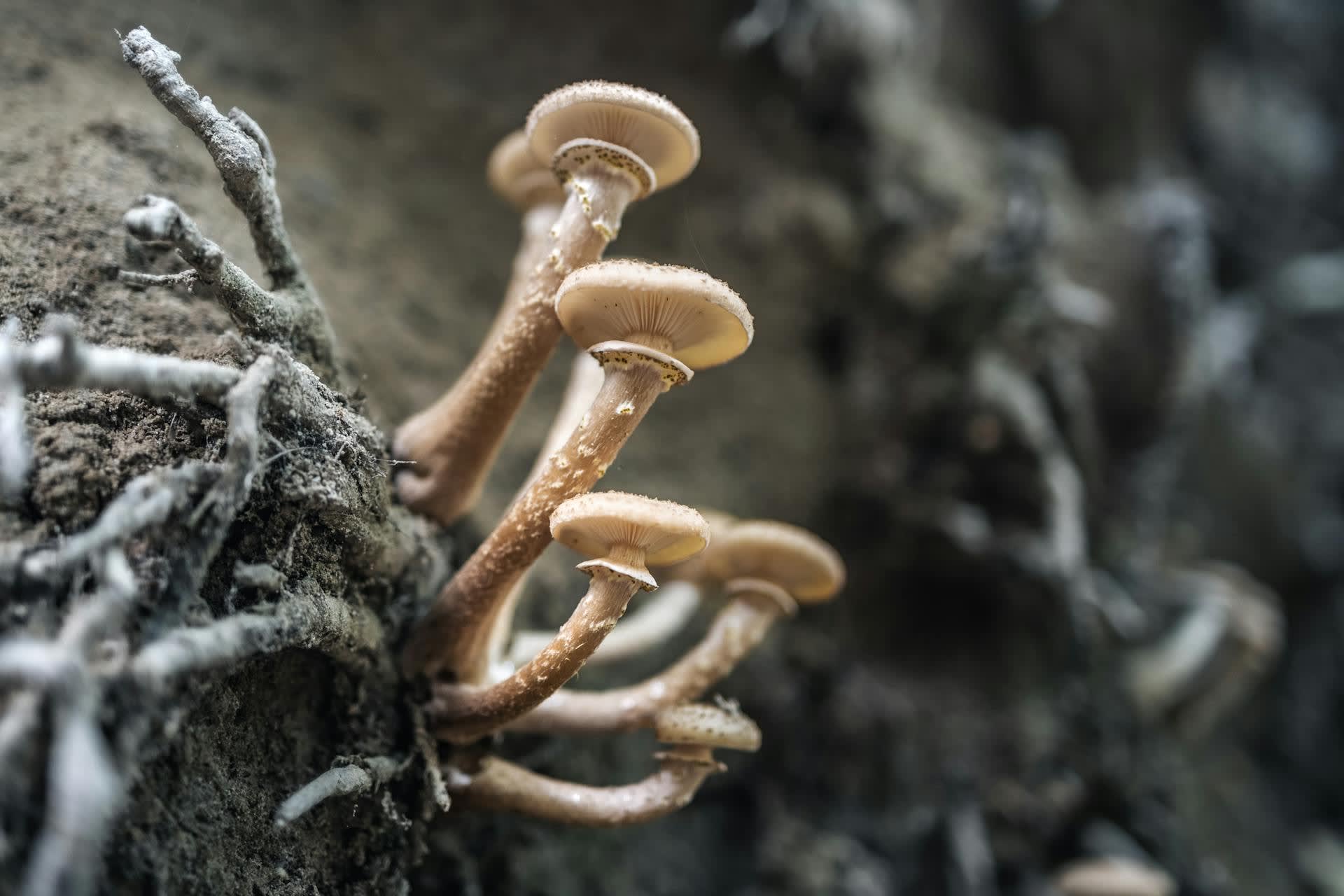
Mushrooms. Thousands of them. Growing in neat rows, in raised beds, in patterns that seemed almost deliberate. Some were small and brown. Others were large and luminescent, glowing faintly in the afternoon shade.
And in the centre of the garden, a small wooden cabin.
Chon's hand went to her phone—no signal. She looked at Aunt Margaret. Margaret nodded.
They approached the cabin slowly, quietly. The door was open.
Inside, a man sat at a table, drinking tea. He was thin, bald, and wearing glasses. His right hand rested on the table, and on it was a tattoo of a mushroom.
The Gardener.
"Chonlatee Intarat," he said without looking up. "I've been expecting you."
Chon stepped inside. Margaret followed, her hand on her weapon—hidden, but ready.
"You know who I am," Chon said.
"I know everyone who's looking for me." The Gardener looked up. His eyes were kind, almost gentle. "I also know why you're here. You want to find the missing people. The ones who came to me."
"Where are they?"
"They're at peace. That's all you need to know."
"They're dead."
"They're free." The Gardener set down his cup. "You have to understand. These people—they were suffering. Every day, every hour, every breath was agony. The doctors couldn't help them. The hospitals couldn't help them. The law couldn't help them."
"So you helped them die."
"I helped them live. One last time." He gestured to the garden outside. "The mushrooms—psilocybin—they open the mind. They dissolve fear. They allow a person to let go of pain, of regret, of the body itself."
"And then they die."
"Yes. But not in terror. Not in agony. They die in peace. In beauty. In connection with something larger than themselves." His voice was passionate. "I've sat with dozens of dying people. I've watched them take their last breath with a smile on their faces. That's not murder. That's mercy."
"The law doesn't see it that way."
"The law is written by people who've never watched a loved one drown in their own fluids. The law is cruel. I am not."
Chon felt the weight of his words. She thought of Mali, alone in her garden. She thought of Pranee, unable to move her arms. She thought of her brother, watching butterflies.
"Where are the bodies?" she asked.
"Buried. In a place where they can nourish new life. New mushrooms. New journeys." The Gardener smiled. "Death feeds life. That's the circle."
"You're using human remains to grow illegal drugs."
"I'm using what the earth provides. The mushrooms are a gift. They help people see. They help people let go." He stood. "I'm not a criminal, Chonlatee. I'm a caretaker."
"Then come with me. Explain that to the police."
The Gardener's smile faded. "I can't do that. The people I've helped—their families would be devastated. Their memories would be tainted. The peace they found would be destroyed."
"They deserve to know the truth."
"The truth?" He laughed—a sad, hollow sound. "The truth is that their loved ones chose to die. Chose to leave. Choose a beautiful ending over a painful one. That's the truth. The rest is just details."
Chon looked at Aunt Margaret. Margaret's face was unreadable.
"Come with us," Chon said again. "Please. Don't make this worse."
The Gardener was silent for a long moment. Then he walked to the door, looked out at his garden.
"I can't," he said. "But I won't run either. Do what you have to do."
Chon called the police. They arrived within two hours—provincial officers, led by a captain who had heard rumours of the Gardener for years.
They searched the cabin. They found journals, photographs, and letters from dozens of missing people. They found maps marking burial sites. They found evidence of psilocybin cultivation on a massive scale.
The Gardener was arrested. He didn't resist. He didn't speak. He walked to the police car with the same calm expression he had worn throughout.
As they drove away, Chon stood in the garden, counting mushrooms. 1,432. Prime factors: 2 × 2 × 2 × 179. 179 was prime.
The numbers were clean. The case was not.
The police exhumed the bodies. Dozens of them, buried in shallow graves throughout the forest, each marked with a small stone and a mushroom.
The families were notified. Some were relieved—finally, closure. Others were devastated—their loved ones had chosen death, had kept secrets, had left without saying goodbye.
Mali came to identify her husband's body. She stood over him for a long time, not crying, just looking.
"He looks peaceful," she said finally. "He didn't look like that at the end. At home. He looked scared. In pain."
Chon stood beside her. "I'm sorry."
"Don't be. You gave me answers. That's what I asked for." Mali turned to her. "Do you think he was happy? At the end?"
"I think he was at peace."
Mali nodded. "Then that's enough."
Aunt Margaret was quiet for days after the arrest. She sat in the Gilded Lotus, drinking tea, staring at nothing.
Chon found her there one evening, the shop closed, the lights dim.
"You're thinking about it," Chon said.
"I'm thinking about what I said. About understanding why people go to him." Margaret looked at her. "I'm also thinking about what I would do if I were in pain. If I were dying."
"Aunt Margaret—"
"I'm not saying I would go to someone like the Gardener. I'm saying I understand the appeal." She set down her cup. "When you get to my age, you start to think about endings. You start to wonder what kind of ending you want."
"You're not dying."
"Everyone is dying, Chon. Some of us have more time than others." Margaret smiled—a sad, gentle smile. "But I'm not ready. Not yet. There's still too much to do. Too many cases to solve. Too many noodles to eat."
Chon sat beside her. "Promise me something."
"What?"
"Promise me that when you're ready—if you're ever ready—you'll tell me. You won't disappear. You won't leave a letter. You'll talk to me."
Margaret was silent for a long moment. Then she took Chon's hand.
"I promise."
Chon visited her brother the next day. He was in the garden again, watching the same butterfly—or a different one; it was hard to tell.
"Sis. You caught him."
"The Gardener. Yes."
"Was he bad?"
Chon sat beside him. "I don't know. He helped people die. People who were suffering. People who wanted to go."
"That doesn't sound bad."
"It's illegal. And he buried the bodies. He didn't tell the families."
Her brother thought about that. "If I were in pain—real pain, the kind that doesn't stop—would you want me to stay?"
Chon's heart broke. "I would want you to be happy. Whatever that means."
"Even if it means leaving?"
"Even then."
He smiled. "You're a good sister."
"I try."
They sat in silence, watching the butterfly. Chon counted its wingbeats—thirty-two per second. Too fast to see, but there, if you knew how to look.
Six months later, Chon received a letter. No return address. Handwritten.
She opened it in the kitchen of her apartment, Margaret beside her, Ning on the phone.
Dear Chonlatee,
I'm writing this from prison. They gave me twenty years. I won't live that long. I have cancer too—did I mention that? It's why I started this work. I wanted to help others avoid the suffering I knew was coming for me.
I don't regret what I did. But I regret the secrets. The lies. The families who never knew.
Thank you for finding me. Thank you for stopping me. And thank you for understanding—even when you didn't agree.
The mushrooms are still growing. Somewhere. They always will because death feeds life. And life is beautiful, even at the end.
The Gardener
Chon folded the letter and tucked it into a drawer. She didn't know what to feel. Anger? Sympathy? Something in between?
Aunt Margaret touched her shoulder. "You did the right thing."
"Did I? He helped people. He gave them peace. And now he's dying alone in a prison cell."
"The law is the law."
"Sometimes the law is wrong."
Margaret was quiet. Then: "Yes. Sometimes it is. But it's all we have. And without it, there's only chaos."
Chon looked at her bookshelf. The colours were still in order. The reds next to the oranges, the blues next to the greens. Order in a world of chaos.
"I need to count something," she said.
"Count your noodles. I'll make dinner."
Chon smiled. "Thank you, Aunt Margaret."
"For what?"
"For being here. For understanding. For not leaving."
Margaret kissed her forehead. "I'm not going anywhere, darling. Not yet."
She walked to the kitchen, and Chon sat alone, counting her breaths, counting her heartbeats, counting the moments between now and whatever came next.
The mushrooms were still growing. Somewhere.
But that was a story for another day.
THE END
Chonlatee Intarat will return.
Chon’s books are available at Amazon: https://amzn.eu/d/000ZmaEs and https://a.co/d/0cKh41HN

Fantastic story! Thank you for sharing it.
Excellent story. Philosophical and thoughtful. I am liking Chon's vulnerability and how the character is becoming more nuanced with each story. Great work.